Saturday, December 31, 2005

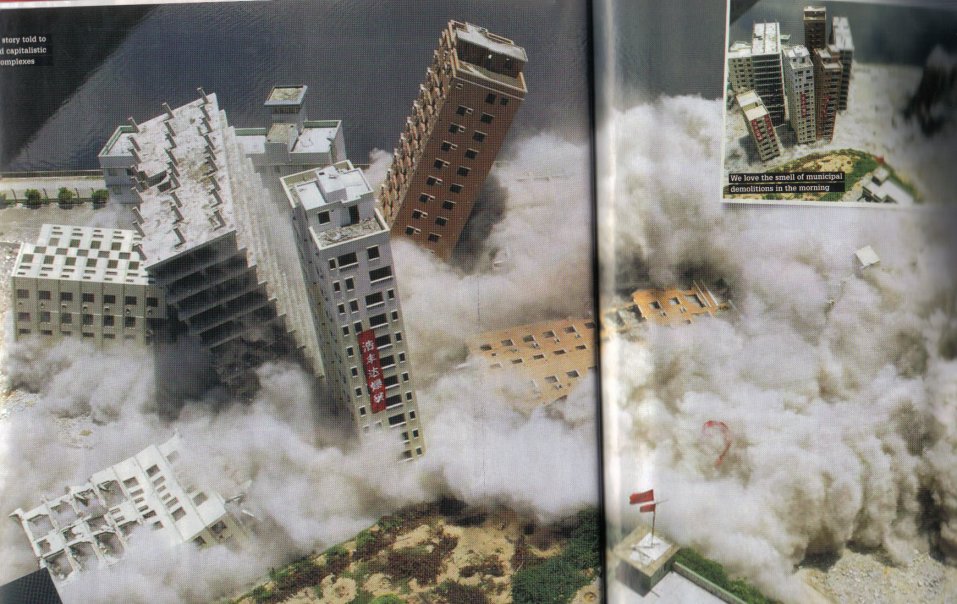
Chinese Demolition

(Click on pic to enlarge)

In case you thought buildings could only fall straight down into their "footprint".

Inset shows the start of the demolition.

(photo scanned from "Maxim" magazine, Sept. 2005 issue; accompanying story)

Tuesday, December 6, 2005

Why It Should Be Obvious by Now That the WTC Towers Were Brought Down by Controlled Demolition

The "official" model for the collapses is that plane damage and fire weakened the structure enough at one floor to cause an upper section of building to break free, causing this upper section to drop down with tremendous force, enough to not only break through the next floor down, but with enough force to initiate a chain-reaction of cascading global collapse. The argument seems to be that once this reaction started, there was no way the lower structure had enough strength to resist this force, and so the whole building collapsed in a pile of steel beams.

There are two basic questions about this argument.

1) First, once a section of building drops down onto the lower section, will it automatically destroy the structure below it by sheer force of the huge mass being propelled downward by gravity?

The answer would seem to be NO, based on two lines of evidence:

a) For the 110 story WTC towers, the bottom layers of construction need to be far stronger than the upper floors, since the 10th floor would be required to support the weight of 100 floors above it, while the 90th floor would only need to support the weight of 20 floors. WTC1 was hit about floor 97, and thus the upper 13 floors (98 - 110) represent at most 12% of the building's total weight, but it is more likely they represented less than 10% of the total weight due to the strength issue. For the collapse of the WTC1 tower, common sense would say that a proportionally small mass of falling debris (9 - 12% of the buildings total mass) which only initially fell approximately 1 story (from 98th to 97th floor), could not crush the intact structure below, especially at the remarkable speed of collapse seen with the WTC1 collapse.

b) The recent failed demolition of the South Dakota feed mill showed how 80% of a tower was not enough to crush the bottom floor, even after the building dropped several stories from demolition.

2) Second, is it even possible for the upper section of a building to break off precipitously such that it generates large downward momentum?

The answer would seem to be NO, based on the following logic:

The most amount of dropping momentum would be obtained if EVERY supporting column on that floor (say floor 97 for WTC1) gave way at the same time and gave way completely (as if it instantly vaporized). But we can safely assume that the chances of this are infinitesimal. So, let's say that half of the supporting columns that are fire weakened give way at the same time (this is probably too many than realistic, but let's go with it). This will require the other 50% of the columns to carry the additional load. Now THESE columns will have more stress put on them. Realistically, the head-failed beams would be located on one side or one corner of the building. So, only that side would fail -- and the top of the building will rotate over and fall off -- thus NOT inducing a global collapse. Right here, we can see that global collapse induced by the sort of column failure mechanism is extremely unlikely.

But, to continue the argument, let's assume that every other column failed, all around the floor. But there is yet another problem -- if half of the columns fail, the remaining columns will have to carry two-times the load they were designed to carry. But the safety factor had to be greater than TWO for a safe structure.

So for a section of building to break off, a full 75% of the supporting columns had to fail. But now, we are getting to a probability approaching zero, making it so unlikely we can discount it as an explanation.

Here are some other considerations:

a. If a large number of columns are going to all fail at the same time, they
need to be evenly distributed if the collapse goes straight down.

b. The proportion of failed columns must be greater than 1/SF (SF =
safety factor).

c. Assuming “N” number of columns fail because of heat, they will
essentially wilt. Heat does not cause brittle failure of steel. As the hot columns wilt, they will do so gradually, say within a minute -- not rapidly. This gradual wilting will not produce impact loading. As a result, the load carried by the remaining columns is gradually increased (even if over a 1-minute duration).
So, now we have a heavy building sitting on fewer columns. There is no rapid initial collapse that will start the chain reaction going.

d. The columns will only buckle if the cross bracing as also been removed. If the column buckles, it can buckle outward or inward, somewhat like an archery bow. That's what the buckled column should be like, as structural steel is a ductile material. So, the buckling column would bend and lower the floor down, gradually (again, over several seconds to a minute time frame).

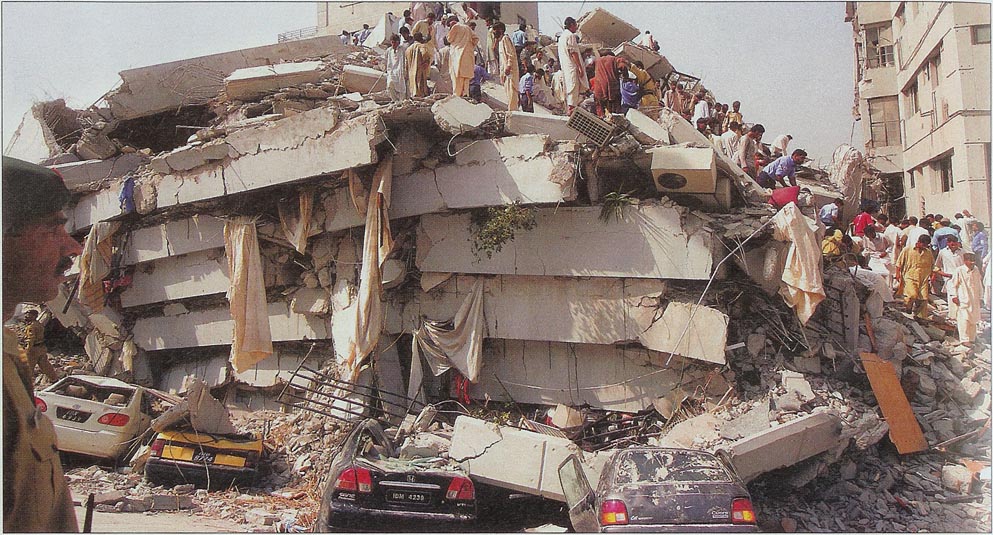
e. Concrete does not turn into powder from simple pancaking of floors. See this picture from the recent earthquake in Pakistan:


There is hardly any sign of dust or powdered concrete around.


These factors all STRONGLY indicate that a precipitous collapse of an upper section of the WTC can not occur simply from plane damage and fire. The only explanation for the collapses, therefore, is some sort of explosive demolition. Explosive demoliiton also accounts for the massive dust clouds that were formed during the collapses of WTC1 and WTC2.

Similar logic holds for WTC7, except we take away the plane damage, making the whole fire-induced collapsed explanation essentially impossible.

(note: this short essay was co-written with a professor of engineering who wishes to remain anonymous)

Pancaking

Saturday, November 19, 2005

The WTC towers did undergo a pancake collapse!

After they blew out the core structure with explosives, that is!

The floors then started progressively falling and piling on each other, in a progressive pancaking fashion, leading to the overall collapse.

Seriously, I think there is some basis to the pancake collapse model. This may be why so many scientists have been able to put the pancake collapse model out as an explanation for what happened on 9/11 and then not feel like they are totally lying.

But the key is that the pancake collapse just doesn't work unless the core is demolished.

Once you watch the 9/11 eyewitness DVD, you will see that all three WTC towers underwent essentially a conventional controlled demolition-- where there was an initial powerful explosion that took out the key support columns in the core. Afyter this, the structure started pancaking by natural gravity-- the outer walls couldn't hold the weight of the floors, and the whole thing gave way. The slowish early initial collapses of the top sections in the beginning of the WTC1 and WTC7 collapses was probably just the pancake collapse starting to gain momentum. Perhaps the first set of charges weakened the core, starting some downward movement, then the final set of charges took it out for good.

Conventional demolition is very similar-- there is an initial set of charges that weakens the structure and then the "killer" charges that cause the structure to collapse at near free-fall speed.

WTC2 was done a little differently-- maybe by mistake or maybe they were testing out the demolitions to see what they needed for WTC1, and thus only did some at a time. The 9/11 eyewitness DVD reveals there were eight or nine explosions right before the WTC2 collapse.

Sunday, November 13, 2005

Jones Goes Public

I posted about Steven Jones, Professor of Physics, who says the WTCs were taken down by Controlled Demolition a couple of months back.

Well, he is in the mainstream news! (picked up via Raw Story)

Here's are some key excertps from the article:
• The three buildings collapsed nearly symmetrically, falling down into their footprints, a phenomenon associated with "controlled demolition" — and even then it's very difficult, he says. "Why would terrorists undertake straight-down collapses of WTC-7 and the Towers when 'toppling over' falls would require much less work and would do much more damage in downtown Manhattan?" Jones asks. "And where would they obtain the necessary skills and access to the buildings for a symmetrical implosion anyway? The 'symmetry data' emphasized here, along with other data, provide strong evidence for an 'inside' job."

• No steel-frame building, before or after the WTC buildings, has ever collapsed due to fire. But explosives can effectively sever steel columns, he says.

• WTC 7, which was not hit by hijacked planes, collapsed in 6.6 seconds, just .6 of a second longer than it would take an object dropped from the roof to hit the ground. "Where is the delay that must be expected due to conservation of momentum, one of the foundational laws of physics?" he asks. "That is, as upper-falling floors strike lower floors — and intact steel support columns — the fall must be significantly impeded by the impacted mass. . . . How do the upper floors fall so quickly, then, and still conserve momentum in the collapsing buildings?" The paradox, he says, "is easily resolved by the explosive demolition hypothesis, whereby explosives quickly removed lower-floor material, including steel support columns, and allow near free-fall-speed collapses." These observations were not analyzed by FEMA, NIST nor the 9/11 Commission, he says.

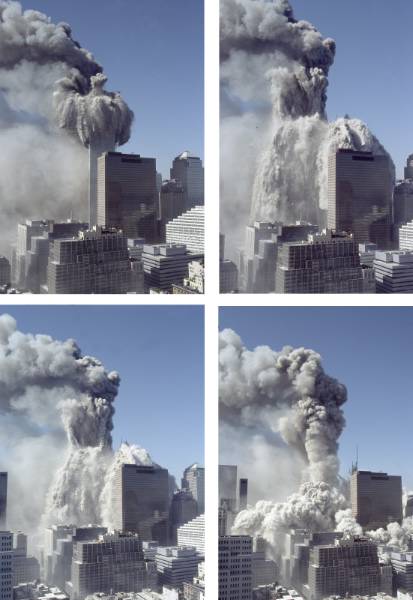
• With non-explosive-caused collapse there would typically be a piling up of shattering concrete. But most of the material in the towers was converted to flour-like powder while the buildings were falling, he says. "How can we understand this strange behavior, without explosives? Remarkable, amazing — and demanding scrutiny since the U.S. government-funded reports failed to analyze this phenomenon."

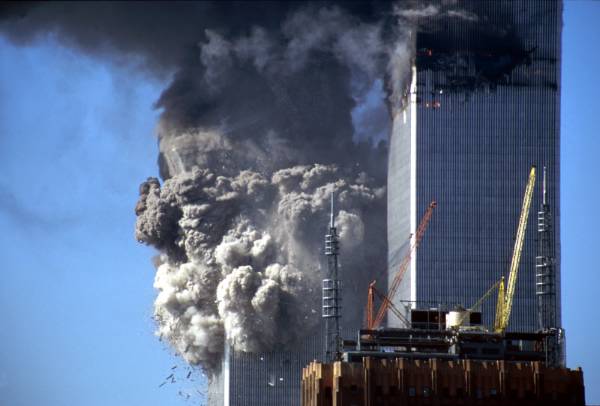
• Horizontal puffs of smoke, known as squibs, were observed proceeding up the side the building, a phenomenon common when pre-positioned explosives are used to demolish buildings, he says.

• Steel supports were "partly evaporated," but it would require temperatures near 5,000 degrees Fahrenheit to evaporate steel — and neither office materials nor diesel fuel can generate temperatures that hot. Fires caused by jet fuel from the hijacked planes lasted at most a few minutes, and office material fires would burn out within about 20 minutes in any given location, he says.

• Molten metal found in the debris of the World Trade Center may have been the result of a high-temperature reaction of a commonly used explosive such as thermite, he says. Buildings not felled by explosives "have insufficient directed energy to result in melting of large quantities of metal," Jones says.

• Multiple loud explosions in rapid sequence were reported by numerous observers in and near the towers, and these explosions occurred far below the region where the planes struck, he says.