Americans are enjoying health benefits courtesy of innovations in medical technology, but they still suffer the consequences of their own lifestyle choices, according to a major report released Wednesday.
The annual complication, "Health, United States, 2009," is published by the Centers for Disease Control and Prevention. The 574-page document reports that one of the biggest transformations in American health care has been the use of technology, especially imaging tests. MRI, CT and PET scans were ordered in 14 percent of emergency room visits in 2007, compared to less than 4 percent in 1996.
The CDC uses the most recent data available to offer a snapshot of American wellness. For 2009, the CDC used information from '06-'07.
Advances in technology are lengthening lifespans, but some experts say the quality of life isn't improving because people continue to have poor diet and exercise habits. Here, a hospital worker prepares a patient for an MRI.
The study offers several reasons to explain the increased use of technology. Machines are more readily available and more effective than they were in the 1990s. But they remain expensive: A single scan costs upwards of $500.
And safety hazards remain a concern. The report notes that imaging tests have been linked to increased rates of cancer, depending on radiation dose. A single CT scan can emit as much radiation as over 400 chest X-rays.
Scans aside, Americans are making use of new medical options. The percentage of those taking at least one prescription drug has soared, from 39 percent between 1988-1994 to 47 percent between 2003-2006. Hip replacements are up by 60 percent. The use of assisted reproductive technology has doubled.
More effective imaging tests, combined with other technological innovations like knee replacements and organ transplants, are credited with improving our life expectancy. A girl born today can anticipate living until age 80, whereas a baby boy will reach 75.
But some experts warn that this technology is improving lifespan, without improving quality of life. "The more societal resources we allocate to medical technology, the less we may devote to supporting the lifestyle practices that can actually build health at its origins," Dr. David L. Katz, director of the Prevention Research Center at Yale School of Public Health.
And quality of life is an area that Americans still need to work on. According to the 33rd edition of the CDC report:
Only 31 percent of us get adequate exercise, and the number hasn't moved in the last decade.
Rates of obesity have doubled since 1976. As of 2006, 35 percent of adult Americans were obese.
More Americans than ever live without health insurance -- 16.6 percent of those under 65. But we're facing more out-of-pocket spending on medical care -- an average of $6,200 per person.
Around 20 percent of American adults still smoke, a decrease of only one percentage point in the last decade.
As life expectancy rises alongside health care costs, the CDC warns that there's a limit to the benefits we can gain from life-saving technology. "Questions remain about how much improvement is possible when resources are scarce and costs continue to increase," the report says.
The potential for technology will no doubt reach a limit, because of the limits of rapid innovation or the cap on our own pocketbooks. If we want to see improvements in health, the CDC report illustrates, our lifestyles and diets are what really need to change.
According to Dr. Robert O. Young, Director of Research at the pH Miracle Living Center, "the key to extraordinary health and fitness throughout ones life is maintaining the alkaline design of the body with an alkaline lifestyle and diet. This lifestyle and diet focuses on daily exercise for at least 1 hour, alkaline food including liberal amounts of green fruit and vegetables, drinking at least 4 liters of alkaline water at a pH of 9.5 daily, ingesting at least 3 ounces of polyunsaturated oils daily and finally eating 12 grams of mineral salts every day."
Thursday, February 25, 2010

Wednesday, February 24, 2010
Equal Opportunity

The latest war news that women may soon be able to serve on submarines and 'officially' be assigned to front line combat roles is seen by some as a great step forward in 'women's rights.'
I'll preface this by saying that I have always been in favor of women having equal rights in all societal aspects to men. Education, work opportunities, politics, pay ... sure, there should be no discrimination.
If a woman wants to show her stuff and kill or be killed right alongside the propagandized men in the military, so be it. Let's not stop them. Free will is always best but let's not encourage them, especially with lies.
My question is why would women want to be equal opportunity killers. Others my disagree but it always seemed to me that women have an innate sense of nurturing life and an aversion to war that historically takes their men from them and leaves their children fatherless. That's not to say that women should be kept barefoot and pregnant but modern day social engineering has attempted to destroy a woman's deep seated feeling to protect life. When that is gone what's left, a barbaric society where the feminine balance to masculine aggressiveness ceases to exist?
Let's not forget that we men would be proud to stand side by side with our women in the protection of our homes and country if violent attacks upon us were real and not the lies and brainwashing of our imperial 'leaders' and media to create enemies in foreign lands. Women have fallen for the scam just have the men.
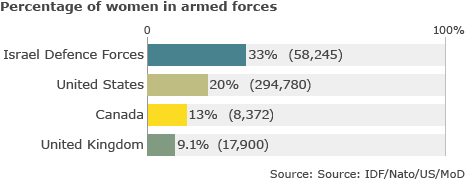 You might look at it as a continuation of the Israelization of our society and military.
Fighting wars for Israel and U.S. hegemony demands both genders fulfill their part.
Fortunately for the military; unemployment, poor education and the increasing destruction of the traditional family have created an underclass where some women see few options other than the military. Leave the kids with someone else, go to war and maybe it will work out. Sometimes it doesn't.
Just this week, Tennessee Army National Guard pilot Billie Jean Grinder, 25 years old of Gallatin, was killed in a helicopter crash Sunday in Iraq, the first woman Guard member to die there since the war began.
"She loved to have a good time." "She had tattoos and liked going fast and doing things that other people might see as dangerous.Equal opportunity to voluntarily bow to our profiteering warlords and to die in vain.
"She had absolutely no fear.
"She was also the sweetest, kindest person you could ever hope to meet."
As the old cliche goes, "You've come a long way baby."
Equal Opportunity
The latest war news that women may soon be able to serve on submarines and 'officially' be assigned to front line combat roles is seen by some as a great step forward in 'women's rights.'
I'll preface this by saying that I have always been in favor of women having equal rights in all societal aspects to men. Education, work opportunities, politics, pay ... sure, there should be no discrimination.
If a woman wants to show her stuff and kill or be killed right alongside the propagandized men in the military, so be it. Let's not stop them. Free will is always best but let's not encourage them, especially with lies.
My question is why would women want to be equal opportunity killers. Others my disagree but it always seemed to me that women have an innate sense of nurturing life and an aversion to war that historically takes their men from them and leaves their children fatherless. That's not to say that women should be kept barefoot and pregnant but modern day social engineering has attempted to destroy a woman's deep seated feeling to protect life. When that is gone what's left, a barbaric society where the feminine balance to masculine aggressiveness ceases to exist?
Let's not forget that we men would be proud to stand side by side with our women in the protection of our homes and country if violent attacks upon us were real and not the lies and brainwashing of our imperial 'leaders' and media to create enemies in foreign lands. Women have fallen for the scam just have the men.
You might look at it as a continuation of the Israelization of our society and military.Fighting wars for Israel and U.S. hegemony demands both genders fulfill their part.
Fortunately for the military; unemployment, poor education and the increasing destruction of the traditional family have created an underclass where some women see few options other than the military. Leave the kids with someone else, go to war and maybe it will work out. Sometimes it doesn't.
Just this week, Tennessee Army National Guard pilot Billie Jean Grinder, 25 years old of Gallatin, was killed in a helicopter crash Sunday in Iraq, the first woman Guard member to die there since the war began.
"She loved to have a good time." "She had tattoos and liked going fast and doing things that other people might see as dangerous.Equal opportunity to voluntarily bow to our profiteering warlords and to die in vain.
"She had absolutely no fear.
"She was also the sweetest, kindest person you could ever hope to meet."
As the old cliche goes, "You've come a long way baby."
Food, Nutrition and the Prevention of Dis-Ease
- What are phytonutrients and where are they found?
- What are the major classes of phytonutrients?
- How do phytonutrients protect against acidic dis-eases?
- What is the evidence that fruit and vegetable consumption protects human health?
- Are Americans eating enough fruits and vegetables?
- What is the present state of phytonutrient research?
1. What are phytonutrients and where are they found?
The term "phyto" originated from a Greek word meaning plant. Phytonutrients are certain organic components of plants, and these components are thought to promote human health. Fruit, vegetables, grains, legumes, and nuts are rich sources of phytonutrients. Unlike the traditional nutrients (protein, fat, vitamins, minerals), phytonutrients are not "essential" for life, so some people prefer the term "phytochemical".
2. What are the Major Classes of Phytonutrients?
Some of the common classes of phytonutrients include:
About Carotenoids
Of all the phytonutrients, we probably know the most about carotenoids, the red, orange and yellow pigments in fruit and vegetables. The carotenoids most commonly found in vegetables (and in plasma) are listed below along with common sources of these compounds. Fruit and vegetables that are high in carotenoids appear to protect humans against certain cancerous conditions, heart disease and age related macular degeneration.
Carotenoid
Common Food Source
alpha-carotene
carrots, grasses, sprouts
beta-carotene
leafy green and yellow vegetables (eg broccoli, sweet potato, pumpkin, carrots), grasses, sprouts
beta-cryptoxanthin
citrus, peaches, apricots, sprouts
lutein
leafy greens such as kale, spinach, turnip greens, grasses, sprouts
lycopene
luctene
tomato products, pink grapefruit
avocado products
zeaxanthin
green vegetables, citrus, grasses, sprouts
For a more detailed discussion of carotenoid content of fruit and vegetables see Chug-Ahuja et al, Journal of the American Dietetic Association, 1993;93:318 and Mangels et al. Journal of the American Dietetic Association, 1993;93:284-296. For carotenoid values of specific foods see the USDA-NCC Carotenoid Database for U.S. Foods on the website of the Nutrient Database Laboratory.
About Polyphenols
Polyphenolic compounds are natural components of a wide variety of plants; they are also known as secondary plant metabolites. Food sources rich in polyphenols include onion, pine bark, apple, tea, red grape, grape juice, strawberries, raspberries, blueberries, cranberries, and certain nuts. The average polyphenol / flavonoid intake in the U.S. has not been determined with precision, in large part, because there is presently no U.S. national food database for these compounds. (USDA scientists and their colleagues are in the process of developing a database for foods rich in polyphenols.) It has been estimated that in the Dutch diet a subset of flavonoids (flavonols and flavones) provide 23 mg per day. Earlier estimates of dietary intake that approximated 650 mg per day (Kuhnau, World Review of Nutrition and Dietetics, 1976;24:117) are generally thought to be too high as the estimate was based on data that were generated by "old" (less specific) methodology. Scientists at the Food Composition Laboratory, Beltsville Human Nutrition Research Center are currently developing new methodology for the accurate measurement of polyphenols in foods.
Polyphenols can be classified as non-flavonoids and flavonoids. The flavonoids quercetin and catechins are the most extensively studied polyphenols relative to absorption and metabolism.
Nonflavonoids
Sources
ellagic acid
strawberries, blueberries, raspberries
coumarins
Flavonoids
Sources
anthocyanins
fruit, pine bark, grasses, sprouts
catechins
grape, grape seed
flavanones
citrus
flavones
fruit, vegetables, grasses and sprouts
flavonols
fruit, vegetables, grasses and sprouts
isoflavones
soybeans, soy sprouts
3. How do phytonutrients protect against disease?
The following are commonly proposed mechanisms by which phytonutrients may protect human health. More research is needed to firmly establish the mechanisms of action of the various phytochemicals.
Phytonutrients may:
- serve as antioxidants or anti-acids
- supports immune response in helping maintain the integrity of the internal environment
- enhance cell-to-cell communication
- reduce estrogen as an acidic waste product of reproductive function
- convert to vitamin A (beta-carotene is metabolized to vitamin A)
- cause cancerous cells to biologically transform (apoptosis)
- repair DNA damage caused by smoking and other toxic exposures
- detoxify carcinogens through the activation of the cytocrome P450 and Phase II enzyme systems
- chelate environmental, dietary and metabolic acids that cause all sickness and dis-ease.
4. What is the evidence that fruit and vegetable consumption protects human health?
Evidence that fruit and vegetable consumption protects human health is accumulating from large population (epidemiological) studies, human feeding studies, and cell culture studies. Listed below are a few selected population studies from the literature linking fruit and vegetable consumption to health. For an excellent review concerning vegetables, fruit and cancer prevention, see Steinmetz and Potter, Journal of the American Dietetic Association 1996;96:1027.
See the World Cancer Research and American Institute for Cancer Research 10 year study on Food, Nutrition, and the Prevention of Cancer: a Global Perspective.
Evidence that Carotenoids are Protective
Fruit and vegetable consumption has been linked to decreased risk of stroke -- both hemorrhagic and ischemic stroke. Each increment of three daily servings of fruit and vegetables equated to a 22% decrease in risk of stroke, including transient ischemic attack (Gillman et al. Journal of the American Medical Association. 1995;273;1113).
Elderly men whose intake of dark green and deep yellow vegetable put them in the highest quartile for consumption of these vegetables had about a 46% decrease in risk of heart disease relative to men who ranked in the lowest quartile. Men in the highest quintile had about a 70% lower risk of cancer than did their counterparts in the lowest quintile. The differences in vegetable consumption between high and low intake rankings was not striking. Men in the highest quartile or quintile consumed more than two (>2.05 and >2.2) servings of dark green or deep yellow vegetable a day; those in the lowest quartile or quintile consumed less than one serving daily (<0.8>
Consumption of tomato products has been linked to decreased risk of prostate cancer. Men in the highest quintile for consumption of tomato products (10 or more servings a week) had about a 35% decrease in risk of prostate cancer compared to counterparts whose consumption put them in the lowest quintile (1.5 or fewer servings of tomato products a week) (Giovannucci et al. Journal of the National Cancer Institute 1995;87:1767).
People in the highest quintile for consumption of spinach or collard greens, plants high in the carotenoid lutein, had a 46% decrease in risk of age-related macular degeneration compared to those in the lowest quintile who consumed these vegetables less than once per month (Seddon et al. Journal of the American Medical Association. 1994;272:1413).
Evidence that Polyphenols are Protective
Flavonoid consumption has been linked to lower risk of heart disease in some, but not all, studies. Elderly Dutch men in the highest tertile of flavonoid intake had a risk of heart disease that was about 58% lower than that of counterparts in the lowest tertile of intake. Those in the lowest tertile consumed 19 mg or less of flavonoids per day, whereas those in the highest tertile consumed approximately 30 mg per day or more (Hertog et al. Lancet. 1993;342:1007). Similarly, Finnish subjects with the highest quartile of flavonoid intake had a risk of mortality from heart disease that was about 27% (for women) and 33% (form men) lower than that of those in the lowest quartile (Knekt et al. British Medical Journal. 1996;312:478).
However, in other studies the protective effect of flavonoids could not be confirmed. For Welch men, flavonol intake did not predict a lower rate of ischemic heart disease and was weakly positively associated with ischemic heart disease mortality (Hertog et al. American Journal of Clinical Nutrition. 1997;65:1489). For U.S. male health professionals, data did not support a strong link between intake of flavonoids and coronary heart disease (Rimm et al. Annals of Internal Medicine. 1996;125:384).
5. Are Americans Eating Enough Fruit and Vegetables?
An excellent source of information on fruit, vegetable and grain intake of Americans is USDA's 1994/96 Continuing Survey of Food Intakes by Individuals conducted by the Food Surveys Research Group, Beltsville Human Nutrition Research Center. The following information comes from that survey
.
About Vegetable Intake
On average, Americans consume 3.3 servings of vegetables a day. However, dark green vegetables and deep yellow vegetables each represent only 0.2 daily servings.
On any given day, about 49% of the population consumes at least the minimum number of servings of vegetables recommended (3 servings per day); 41% consume the number of servings recommended based on caloric intake (3 servings per day for those consuming less than 2200 calories, 4 servings per day for those consuming 2200-2800 calories, 5 servings per day for those consuming 2800 calories or more). About 10% of the population consumes less than one serving of vegetable per day.
About Fruit Intake
On any given day about 29% of the population consumes at least the minimum number of servings of fruit recommended (2 servings per day); 24% consume the number of servings recommended based on caloric intake (2 servings per day for those consuming less than 2200 calories, 3 for those consuming 2800 calories, 4 for those consuming 2800 calories or more). About 48% consume less than one serving of fruit a day.
6. What is the Present Status of the Art of Phytonutrients Research?
Population studies have linked fruit and vegetable consumption with lowering the risk for chronic diseases including specific cancerous conditions and heart dis-ease. However, media and consumer interest in phytonutrients and functional foods is far ahead of established proof that documents the health benefits of these foods or food components for humans. Phytonutrients research is experiencing remarkable growth. Hopefully, more specific information on phytonutrient consumption and human health will be forthcoming in the near future. For now, it appears that an effective strategy for reducing risk of cancerous conditions and heart dis-ease is to increase consumption of alkalizing, electron-rich phytonutrient-rich foods including green fruit, vegetables, grasses, seeds, nuts and sprouts.
Tuesday, February 23, 2010
Five Dancing Israelis Lie About Their Involvement in 9/11
This clip is taken from a Channel 4 British documentary called "The 911 Conspiracies". This part investigates the "dancing Israelis" incident which has sparked widespread speculation and suspicion of Israeli involvement in 9/11. The documentary actually interviews the 5 men in Israel in 2004. The men say they are innocent of all claims made against them and were simply "vacationing" and just happened to be in New Jersey and able to film the attack. Obviously they are lying. Many points can be made that would blow their "innocent vacationers acting immaturely" story out of the water. What a sick lie. MossadDid911
H/T andie531's blog
H/T andie531's blog
The Dancing Israelis on TV
The Five Dancing Israelis Arrested on 9/11
Israel: A Definition
All the Proof in the World
Questioning Our Special Relationship with Israel
Five Dancing Israelis Lie About Their Involvement in 9/11
This clip is taken from a Channel 4 British documentary called "The 911 Conspiracies". This part investigates the "dancing Israelis" incident which has sparked widespread speculation and suspicion of Israeli involvement in 9/11. The documentary actually interviews the 5 men in Israel in 2004. The men say they are innocent of all claims made against them and were simply "vacationing" and just happened to be in New Jersey and able to film the attack. Obviously they are lying. Many points can be made that would blow their "innocent vacationers acting immaturely" story out of the water. What a sick lie. MossadDid911
H/T andie531's blog
H/T andie531's blog
The Dancing Israelis on TV
The Five Dancing Israelis Arrested on 9/11
Israel: A Definition
All the Proof in the World
Questioning Our Special Relationship with Israel
The 25,000? The thromboembolism lies
Following up on my last piece on the government's spinning of the thromboembolism death statistics, it turns out that less than three thousand people die as a result of venous thromboembolism per year, this is according to the 2008 statistics.The Department of Health and NICE both reference the Health Select Committee on this 25,000 figure. Strangely the Health Select Committee was presented
Subscribe to:
Posts (Atom)


